
The Shift No One Plans For
For most growing businesses, VoIP or UCaaS does exactly what it was meant to do. Calls come in, employees answer them, transfers work, and customers reach a real person. From a day-to-day operational standpoint, the system works.
The challenge rarely begins with technical failure. It begins with new expectations.
As organizations grow, leadership conversations start to change. Instead of asking whether the phones are working, executives begin asking how well they are working. They want to know how many inbound calls were answered, how long customers waited on hold, how many callers hung up before reaching someone, and what happens during peak call periods.
At that moment, the issue is no longer connectivity. It is visibility.
And that shift is happening across industries. According to Gartner, customer experience has become a primary competitive differentiator for organizations, often overtaking price and product in buying decisions. Communication performance is no longer just an IT issue. It is a business metric.

The Natural Evolution of Business Communications
Most companies follow a predictable path. They move from traditional phone systems to VoIP. As collaboration needs increase, they adopt UCaaS to unify messaging, meetings, and mobility across devices and locations.
For a long time, that combination is more than enough. These platforms handle the core communication needs of the business. They are reliable, flexible, and efficient.
But growth changes what leadership expects from communication tools. Around 50 users and beyond, or whenever inbound volume becomes meaningful, communication stops being just an operational function and becomes something that must be measured.
That is where CCaaS or CXaaS enters the picture.
This shift is not theoretical. According to Fortune Business Insights, the global Contact Center as a Service market was valued at over $4 billion in 2023 and is projected to grow at more than 15 percent annually through 2030. The growth is being driven largely by demand for analytics, reporting, automation, and multi-channel engagement.
Organizations are not replacing systems because their phones stopped working. They are evolving because management expectations changed.

“We’re Not a Contact Center”
One of the biggest misconceptions is that CCaaS is only for companies that consider themselves contact centers.
Many businesses dismiss the idea immediately. They do not have large support teams or formal call center departments.
Yet operationally, many of these businesses function like one. If your team handles steady inbound call traffic, routes calls across departments, experiences peak periods that strain staff, or worries about missed calls, you are managing contact center dynamics whether you use that term or not.
Traditional VoIP and even many UCaaS systems were built to enable communication, not to deeply analyze it.
Customer expectations reinforce this need for insight. If callers are waiting too long or abandoning calls, it directly affects how your business is perceived. That is why visibility matters.

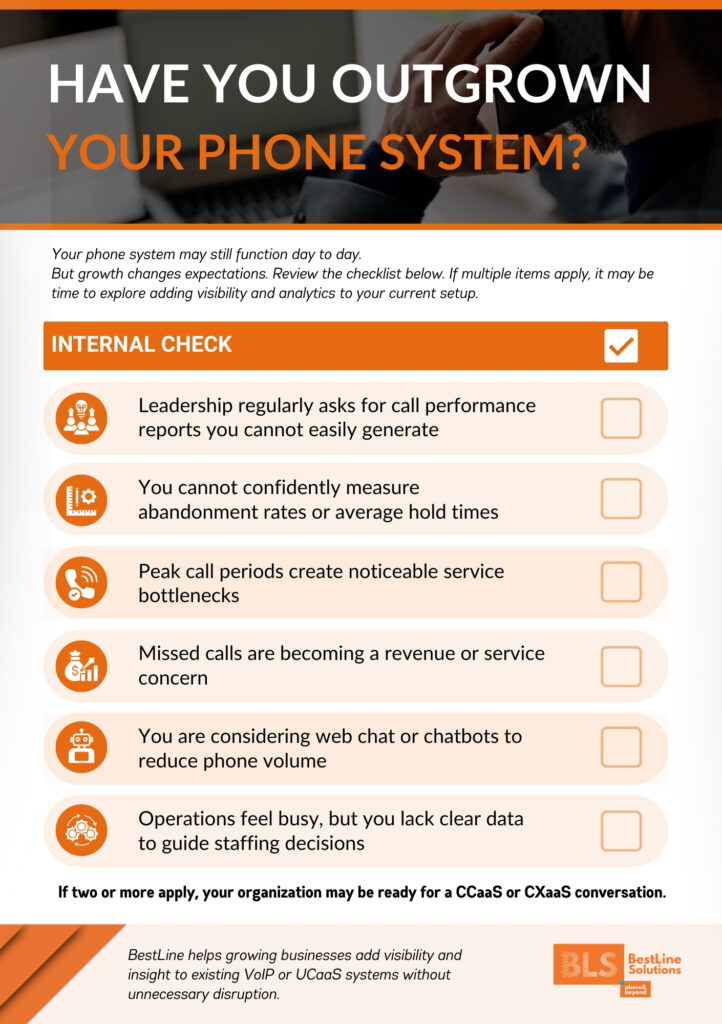
When Operations Feel Fine, But Management Lacks Insight
The tipping point is subtle. The phones still ring. Employees still answer them. Customers are still served.
But leadership cannot clearly see what is happening behind the scenes.
They cannot easily measure abandonment rates or average hold times. They cannot identify peak traffic patterns with confidence. They cannot determine whether staffing levels align with call volume trends.
And the stakes are measurable. Research from SQM Group has shown that call abandonment rates above five percent can significantly reduce customer satisfaction and first-call resolution rates. In high-volume environments, missed calls often translate directly into lost revenue opportunities.
Without reliable reporting, decisions become reactive. Staffing adjustments, service improvements, and performance evaluations rely more on perception than data.
That gap between operational success and strategic insight is often the clearest signal that a business has outgrown its current communications setup.
A Practical Example
Consider a growing medical practice. Each doctor may see dozens of patients daily, while the front desk manages a constant stream of inbound calls for scheduling, rescheduling, insurance questions, and follow-ups.
A traditional VoIP system can route those calls. It can provide auto-attendants and voicemail. On the surface, everything works.
But administrators may not have clear data on how long patients wait on hold, how many calls are abandoned during busy periods, or when call volume peaks throughout the day. Without that information, improving patient experience and staffing decisions becomes difficult.
Adding a CCaaS or CXaaS layer introduces structured reporting, queue management, and additional communication channels such as web chat or chatbot automation. It allows leadership to see trends, measure performance, and proactively improve service rather than react to complaints.
The practice may not identify as a contact center. Functionally, however, it manages continuous inbound engagement similar to one.
An Add-On, Not a Rip-and-Replace
Importantly, moving toward CCaaS or CXaaS does not typically require abandoning your existing VoIP or UCaaS platform. In many cases, it integrates alongside what you already use.
Think of it as adding intelligence and visibility to your current system, not replacing it.
Your core communication tools continue handling calls and collaboration. The added layer provides the analytics, reporting, and experience management capabilities that growing organizations increasingly expect.

Recognizing the Moment
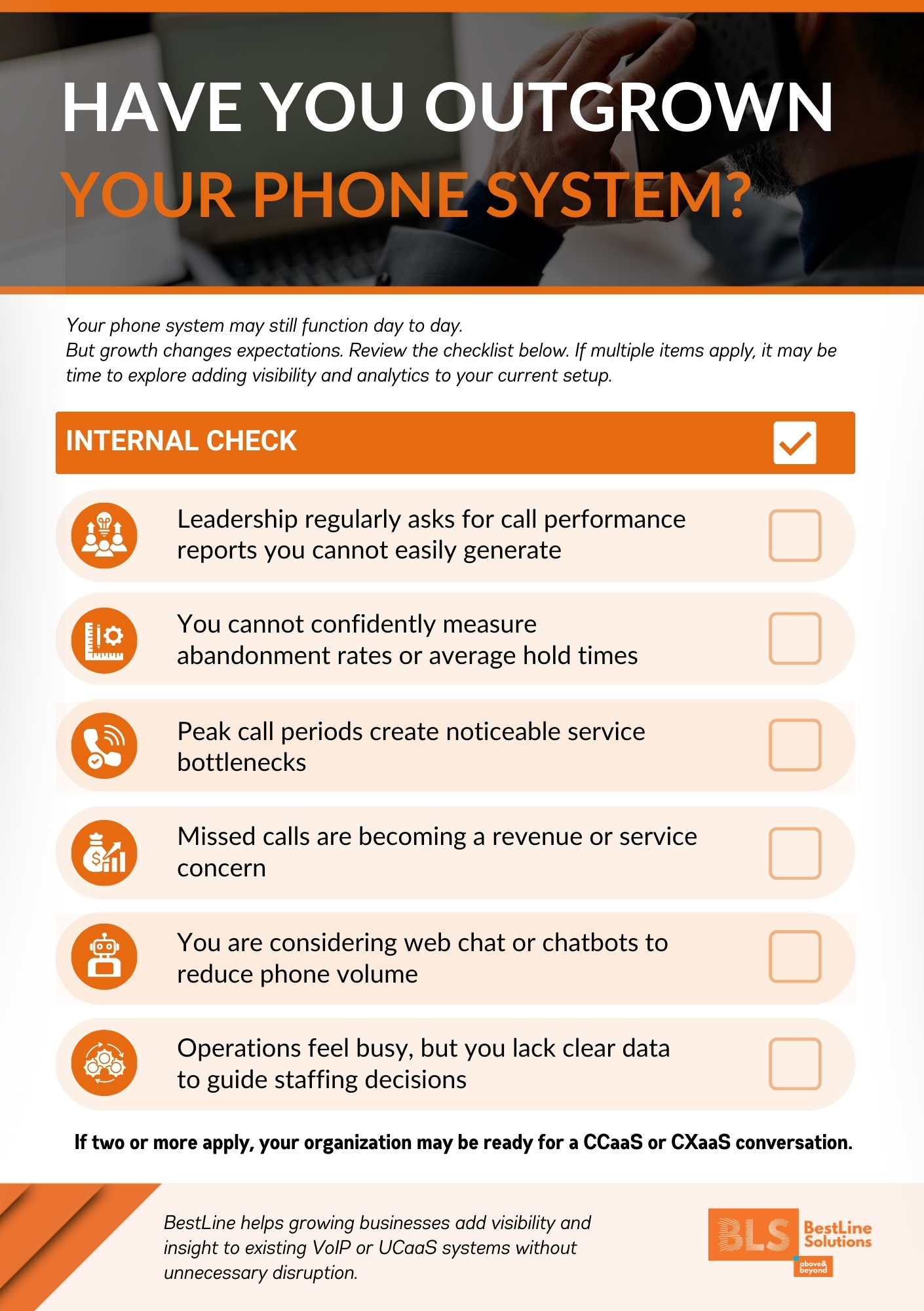
If your phone system still works but leadership keeps asking for reports you cannot easily produce, that is often the moment to pause.
The conversation is no longer about upgrading hardware or switching providers. It is about aligning communication tools with the expectations of a growing organization.
When visibility becomes just as important as functionality, it may be time to explore what CCaaS or CXaaS could add on top of your current setup.
Not as a forced jump.
Not as a dramatic overhaul.
But as the next logical step in supporting growth, accountability, and customer experience.
Frequently Asked Questions
What is the difference between VoIP and CCaaS?
VoIP handles internet-based calling, while CCaaS adds contact-center features like call queues, routing, analytics, reporting, customer interaction tracking, and performance visibility. A VoIP system can still work perfectly for making and receiving calls, but leadership may need more insight into what is happening during busy periods. CCaaS is useful when the business wants to measure hold times, missed calls, abandonment, staffing patterns, and customer experience. It is less about replacing phones and more about adding visibility.
Do you need CCaaS if you are not a call center?
You may need CCaaS even if you do not call yourself a call center. If your team handles steady inbound calls, transfers callers between departments, deals with peak call periods, or worries about missed calls, you are managing contact-center dynamics. Many medical offices, service businesses, property managers, and professional firms fit this pattern. The issue is not the label. The issue is whether leadership needs better reporting, routing, and visibility than a basic phone system provides.
How do you know when your phone system is not enough anymore?
Your phone system may no longer be enough when leadership asks questions the system cannot answer. Common examples include how many calls were missed, how long callers waited, when peak periods happen, which departments are overloaded, and whether staffing matches call volume. The phones may still ring, but the business lacks visibility. That is usually the point where CCaaS or CXaaS should be evaluated. The goal is to improve service decisions with data, not just keep calls connected.
Can CCaaS work with an existing VoIP system?
In many cases, CCaaS can work alongside an existing VoIP or UCaaS system instead of requiring a full rip-and-replace. It can add call analytics, queue management, reporting, and customer experience tools on top of the communication setup the business already uses. The right approach depends on the current phone platform, integrations, call flows, and reporting needs. Before replacing anything, ask whether the missing piece is phone functionality or leadership visibility.
What call metrics should leadership track?
Leadership should track missed calls, abandoned calls, average hold time, call volume by hour, peak periods, queue performance, first-call resolution, call routing outcomes, and agent or department availability. These metrics help leaders see whether customers are reaching the right people quickly. Without reporting, staffing and service decisions rely on anecdotes. Businesses with meaningful inbound call volume should review these metrics regularly and use them to improve scheduling, routing, training, and customer experience.