
Technology setups rarely get complicated overnight. Most businesses add providers slowly, across years of growth, new projects, and shifting needs. One company sets up your internet. Another runs your phones. A separate provider handles day-to-day IT. Your security cameras come through someone else. Cybersecurity sits with a different firm, and your cloud tools are looked after on their own.
Each choice made sense the day you made it. Put together, though, you end up with a scattered environment that quietly pulls at your time, your budget, and your attention. Eventually you notice something uncomfortable. You spend almost as much energy managing the providers as you do running the technology itself.
That is the hidden cost this guide pulls apart. It rarely shows up on an invoice, yet it shapes how quickly you fix problems, how clearly you plan ahead, and how much of your week disappears into coordination calls. Once you can see it, you can start to reduce it.

The True Cost of Technology Goes Beyond the Monthly Invoice
Most leaders measure technology spend by the recurring charges they can point to. But there is a second cost that never appears as a line item. Call it the management cost. It includes the leadership hours spent in vendor meetings, the admin work of paying and filing separate invoices, the back and forth of coordinating support, the effort of tracking contracts and renewal dates, and the lost productivity when your team stops its real work to chase a provider.
This cost is higher than most people guess, because the number of tools keeps climbing. Recent industry data show that the average company now runs more than 100 software applications, and each tends to have its own login, billing, and support processes. Vendor work piles up alongside it. One 2025 analysis found that IT teams spend nearly a quarter of their time managing vendors rather than improving the systems that drive the business forward.
When you add that up, the true price of your technology is not only what you pay for it. It is also the time it takes to manage it. A cheaper monthly rate can hide a much higher management cost, and that trade rarely shows up in a budget review.

When Nobody Owns the Problem
The clearest sign of vendor overload shows up the moment something breaks.
Picture a normal bad morning. Calls keep dropping. You phone your internet provider, and they tell you the connection looks fine, so it must be the phone system. You call the phone provider, and they point at the firewall. The security vendor says the network is the issue. Your IT provider says they are waiting to hear back from one of the others.
Every provider is technically doing their job. Each one looks at their own slice and sees no fault. Meanwhile, the actual problem sits in the space between them, and no single party feels responsible for the whole thing. You become the go-between, relaying messages and trying to host a group project among companies that have never spoken.
This is an accountability gap, and it gets expensive quickly. Downtime is not a rounding error for a smaller business. For a company of about 20 people earning $5 million a year, an outage can cost roughly $3,300 an hour, or about $27,000 across a single day offline. A large share of that loss is not the failure itself. It is the slow, scattered scramble to figure out who owns the fix.
The painful part is that the technology often was not the real failure, but coordination.

Complexity Costs More Than You Expect
Each provider you add brings its own way of doing things. On its own, each one feels manageable. Stacked together, they create a steady drag on the whole operation.
Think about what your team actually carries. Several support portals, each with a different login. A separate account manager for every service, none of whom knows the full picture. Contract renewal dates scattered across the calendar. A pile of invoices that never quite line up. Maintenance windows that land at different times and sometimes collide. And advice that conflicts, because each provider recommends what is best for their product, not what is best for your business as a whole.
None of these is a crisis by itself. The cost is in the accumulation. This is what vendor sprawl really feels like day to day. It is not one dramatic event. It is a hundred small friction points that slow projects, stretch out simple decisions, and wear your people down. Strong vendor management is supposed to keep that friction low, but the more providers you carry, the harder that job becomes, and the more it lands on someone who already has a full plate.
Why Technology Strategy Requires Coordination
Here is the deeper issue. Every provider naturally improves the piece they are responsible for. Almost none of them is responsible for making sure all the pieces work together.
That gap leads to disconnected decisions that look fine on their own and cause trouble later. A provider upgrades your internet speed, but nobody checks if the network behind it can carry the new load. A company installs more cameras, but no one plans for the extra storage all that video needs. You adopt a new cloud tool, and only afterward does the bandwidth strain show up. You upgrade the phone system without a security review, and a new opening goes unnoticed.
A real technology strategy cannot happen one box at a time. Your systems are connected, so the planning has to be connected too. This is where technology governance matters, which simply means having clear rules and a clear owner for how technology decisions get made across the whole business, not just inside each silo. Without that oversight, the harm compounds. One industry survey found that 94% of executives say scattered, manual vendor management leads to poor choices about what they buy and how they spend. When no one sees the full board, the moves get worse over time.

What Technology Vendor Consolidation Really Means
The word consolidation makes some leaders nervous, because it sounds like ripping everything out and starting over. That is not what it means here.
Technology vendor consolidation is not about firing every provider you have or forcing all your services under one logo. It is about governance. The goal is to put one strategic partner in charge of the bigger picture, so the pieces finally line up. That partner coordinates your providers, oversees planning across systems, gives you a central place for support, holds accountability when something goes wrong, and keeps technology decisions tied to your business goals.
You keep choice. You lose the chaos. That distinction is the whole point of IT vendor consolidation done well. You are not collecting fewer tools for its own sake. You are giving someone clear ownership of how those tools fit together.

The Value of One Strategic Technology Partner
When one trusted advisor owns the bigger picture, the daily experience changes in ways you feel right away.
A capable single technology partner does not just react to tickets. They plan. They look ahead at where your business is going and lines up the systems to match, which is what good managed technology services are meant to deliver. Leadership gets its time back for the decisions that actually grow the company, rather than refereeing disputes between providers.
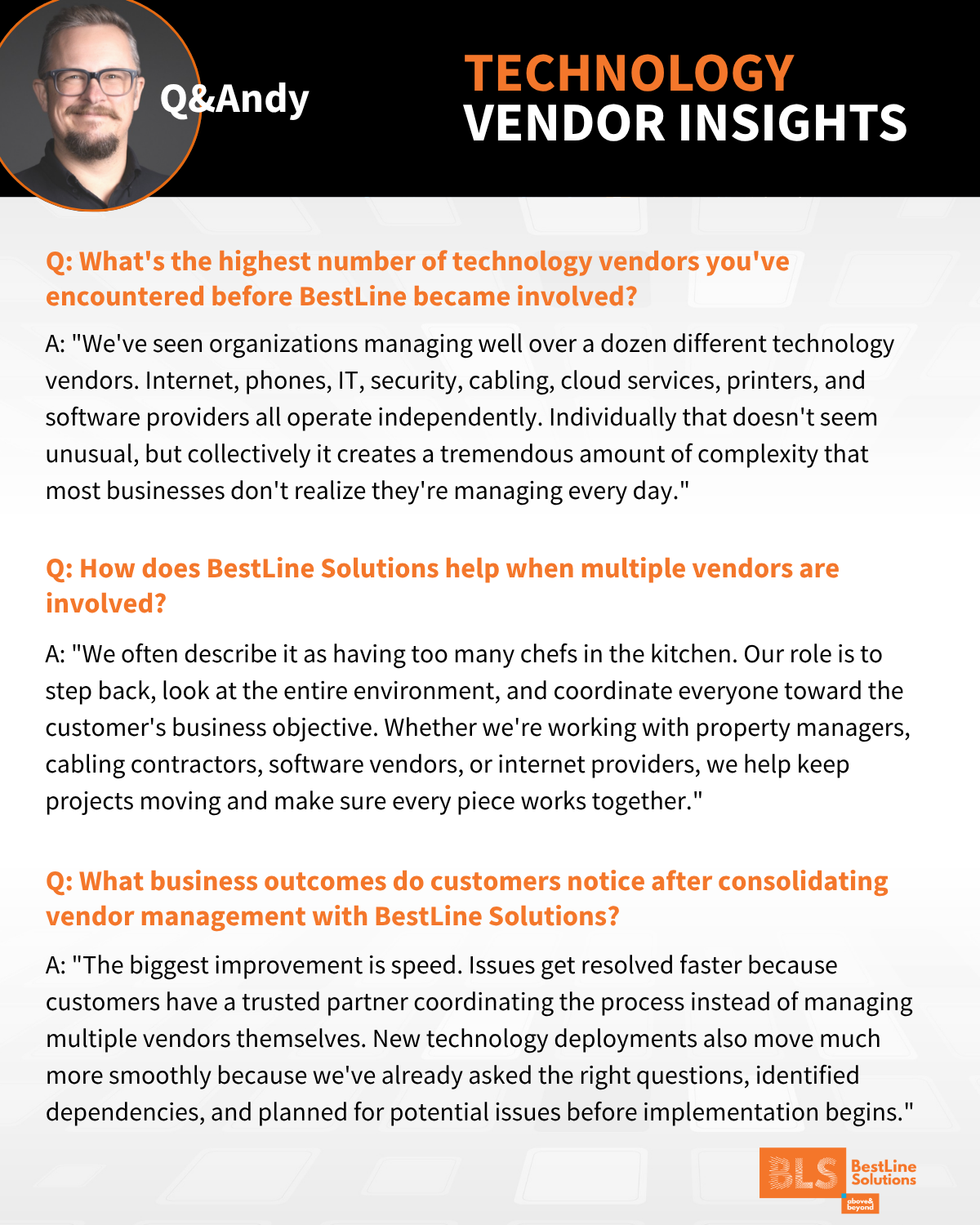
This is the model BestLine Solutions was built around. As an Austin company that has covered the full path across voice, internet, IT, and security for more than 35 years, BestLine acts as one accountable partner across systems that most businesses buy in pieces. The point is not to sell you more. It is to give you a clearer setup and a steadier hand, with proactive managed IT support backing the day-to-day and a single team that owns how it all connects.
You do not have to replace everything at once to get there. A good technology partner starts where you need the most help, proves the value, and expands the relationship over time. Many businesses begin the moment leadership starts asking for reports a basic phone system cannot produce, then bring the rest of the stack under one roof. The thread that ties it together is one owner who keeps the whole picture aligned.
Start by Counting What You Actually Manage
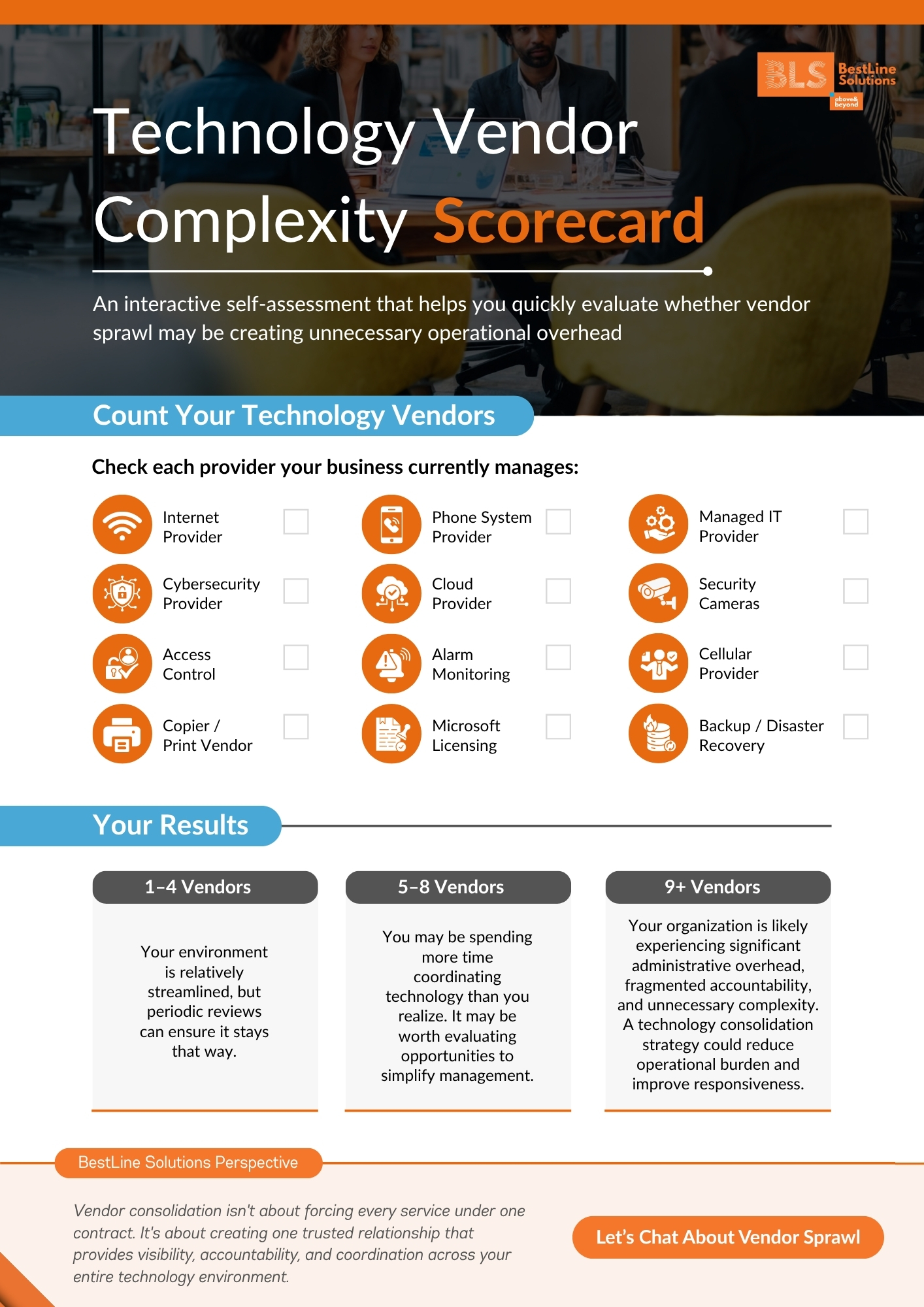
Before you change anything, take stock. List every technology provider you pay. Next to each one, write who owns the relationship, when the contract renews, and who you call when it breaks. Most leaders are surprised by how long the list runs and how many blanks they cannot fill in.
Technology is supposed to make your work simpler, not add a second job of managing the people who run it. The businesses that operate most smoothly are usually not the ones with the most providers or the lowest monthly rates. They are the ones who gave the bigger picture an owner, planned across systems instead of around them, and stopped paying the hidden cost of doing it all in pieces.
You already feel that cost every time you play go-between during an outage. The first step is simply to see it clearly. The next is to decide you no longer have to carry it by yourself. If you would like a second set of eyes on that list, you can book a time to talk through it and map out where one owner could take the weight off your plate.

Frequently Asked Questions
What is technology vendor consolidation?
Technology vendor consolidation is the practice of putting one strategic partner in charge of coordinating your technology providers and planning across systems, instead of managing each provider on its own. It does not always mean replacing every vendor you have. More often, it means giving one accountable partner ownership of how your voice, internet, IT, security, and cloud services fit together. The goal is clearer support, better planning, and one place to turn when something goes wrong.
How is vendor sprawl costing my business money?
Vendor sprawl costs money in ways that rarely appear on an invoice. You pay in leadership hours spent coordinating providers, admin time spent on separate contracts and invoices, and lost productivity when your team stops working to chase a fix. It also slows down problem solving, because no single provider owns the whole issue. Add the cost of downtime during those delays, and the management burden often outweighs the savings of any one low monthly rate.
Will consolidating vendors lock me into a single provider?
Not if it is done well. Good consolidation is about governance, not control. The aim is to give one partner ownership of planning and accountability while you keep the right to choose. Look for a partner that offers flexible terms and earns the relationship over time, rather than one that demands you hand over everything at once. You should always stay in charge of the decisions.
How do I know if I have too many technology vendors?
A few signs point to vendor overload. You cannot quickly name every provider you pay. Contract renewal dates are scattered and easy to miss. During an outage, providers blame each other while you play go-between. Each provider gives advice that suits their product but not your whole business. If two or three of these sound familiar, the management cost of your setup is likely higher than your monthly bills suggest.
Does vendor consolidation reduce IT costs?
It can, though the savings are not only about lower rates. Consolidation tends to cut administrative overhead, reduce duplicated tools, strengthen your position when negotiating, and shrink the time your team loses to coordination. Just as important, it lowers the risk of costly downtime by giving one partner clear ownership of fixes. The biggest return is often the leadership time you reclaim for work that grows the business.