Most organizations believe they have visibility because they have tools.
They have cameras.
Dashboards.
Alerts.
Security software.
Access logs.
Cloud platforms.
Monitoring systems.
But visibility is not the same thing as awareness.
The real problem starts when systems, teams, and workflows operate separately from one another. That’s where blind spots form. Not because businesses are careless, but because growth often creates disconnected layers of technology over time.
A camera records an event, but nobody connects it to the access control logs. An employee leaves, but a cloud account stays active. A vendor gains temporary access, but no one tracks how long it remains open.
These aren’t dramatic Hollywood-style breaches. They’re operational gaps that quietly expand risk, slow response times, frustrate teams, and create uncertainty when something actually goes wrong.
According to Ivanti’s 2025 State of Cybersecurity Report, 45% of organizations report insufficient visibility into software employees use, while 38% lack adequate visibility into devices accessing their network.
The issue isn’t necessarily the absence of technology. It’s the absence of connected visibility.
Here’s what that can look like in the real world.
Story #1: The Employee Who “Left” But Never Really Left

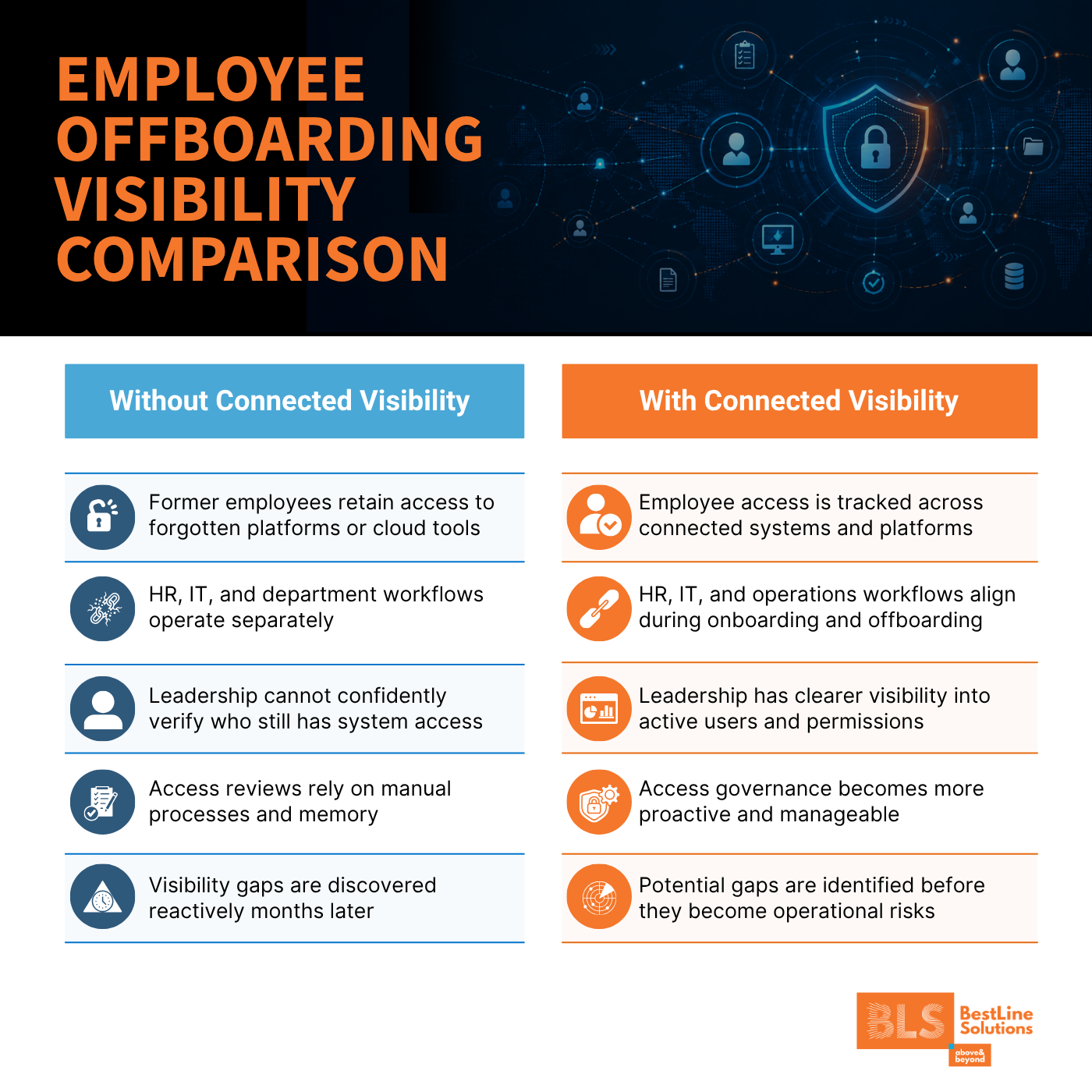
A regional company believed they had a solid onboarding and offboarding process in place. Human resources handled employee transitions carefully, IT disabled company email accounts, managers collected badges and laptops, and leadership felt confident that access was being properly managed across the organization.
Several months after one employee departed, however, the company discovered that the individual still had access to a third-party cloud platform tied to operational reporting. The platform had originally been implemented years earlier by another department, outside of the organization’s standard IT workflow, and over time it simply became disconnected from the company’s normal access management procedures.
There was no malicious activity and no evidence that the former employee had attempted to misuse the account. Still, the discovery created immediate concern because leadership realized they could not confidently answer a much larger question: how many other systems or platforms might still contain lingering access permissions that nobody was actively tracking?
That uncertainty quickly became more troubling than the isolated oversight itself. The issue was not a lack of technology or security tools. It was a lack of unified visibility across departments, vendors, and systems that had gradually evolved independently over time.
This challenge is becoming increasingly common. According to Bedrock Security research, 76% of organizations say they cannot produce a complete inventory of their data assets within hours during a compliance issue or security event. The problem is rarely one missing system. More often, it is the accumulation of disconnected systems that creates operational blind spots leadership never intended to have.
Story #2: The Investigation That Took Three Days Longer Than It Should Have

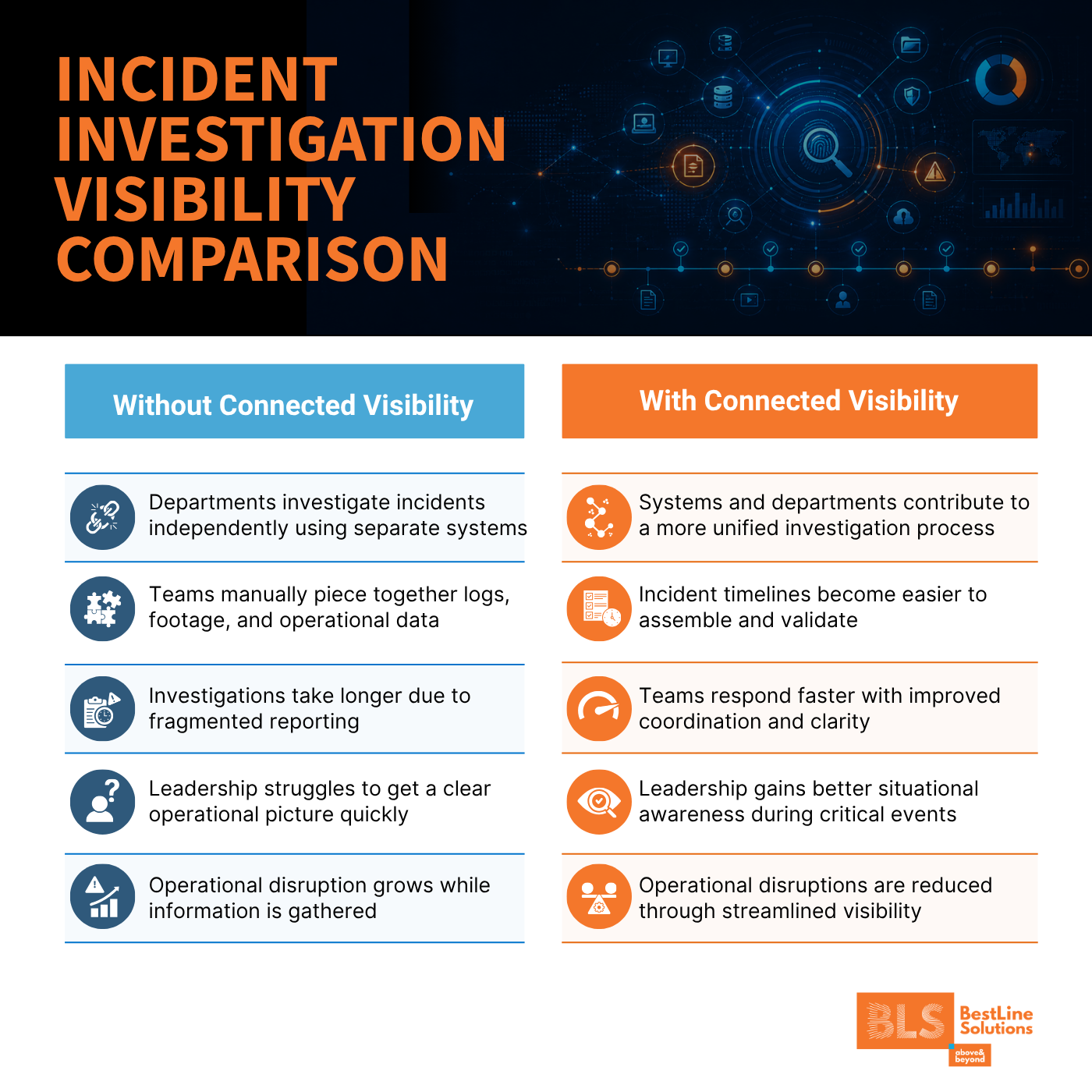
After a late-night incident at one of its facilities, a company began the process of trying to determine exactly what had happened. Facilities teams reviewed badge access records while operations pulled delivery schedules and shipment logs. IT examined network login activity, and leadership requested security footage from multiple camera systems.
Every department contributed useful information, but no single team had a complete picture of the situation.
What should have been a relatively straightforward investigation turned into a slow and frustrating process of manually piecing together fragmented data spread across multiple platforms, vendors, and reporting systems. By the time the organization assembled a reliable timeline of events, several days had passed and the operational disruption surrounding the investigation had become more damaging than the original issue itself.
The experience forced leadership to recognize a problem they had not fully considered before: the organization had invested heavily in systems that generated data, but very little attention had been given to how those systems worked together operationally during moments that required speed, coordination, and clarity.
According to Check Point’s 2025 Cloud Security Report, 40% of organizations say fragmented tools and poor platform integration are actively slowing response times and increasing visibility gaps. In many environments, the challenge is no longer a lack of information. It is the inability to efficiently connect information across disconnected systems when pressure is highest.
The organizations that respond most effectively are not always the ones with the most technology. They are often the ones that have reduced operational friction between systems, teams, and decision-making processes before an incident ever occurs.
Story #3: The “Temporary” Vendor Access Nobody Revisited

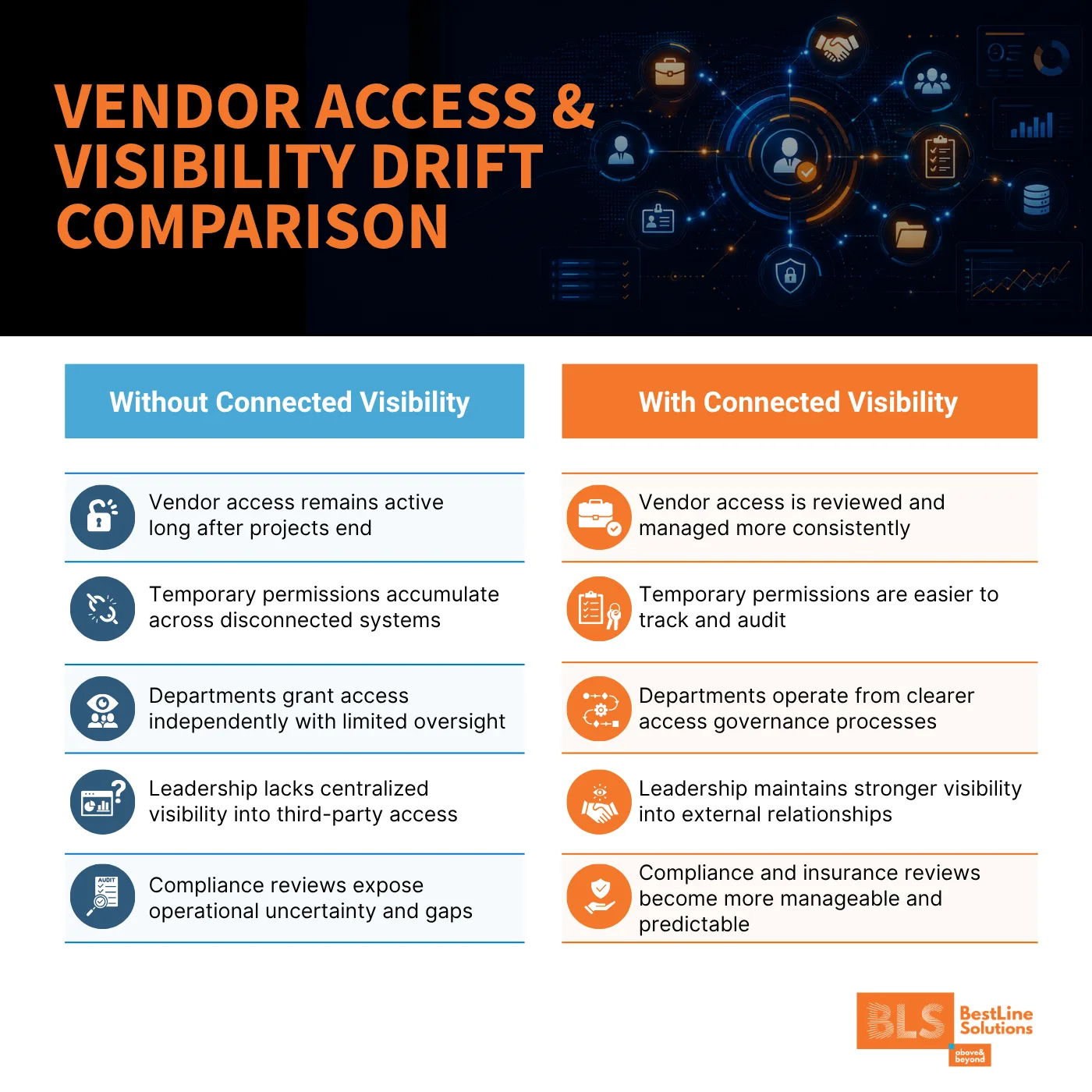
A growing business hired an outside vendor to assist with a short-term operational project. To keep the project moving quickly, access was granted to several systems and platforms so the vendor could collaborate efficiently with internal teams.
The work was completed successfully, the relationship gradually faded, and everyone moved on to the next priority. Months later, during an insurance and compliance review, leadership was asked to document which outside vendors still retained access to certain systems and environments.
What initially seemed like a simple request quickly exposed a much larger issue. No one could provide a fully confident answer.
Over the years, the organization had accumulated a combination of temporary permissions, vendor accounts, legacy integrations, cloud applications, and department-level technology decisions that were never fully revisited after implementation. None of these decisions appeared risky at the time they were made, but collectively they created an environment where visibility had slowly drifted away from leadership’s control.
The concern was not centered around one vendor account. It was the realization that the organization no longer had a clear, centralized understanding of who could access what across the broader environment.
This type of visibility drift is becoming a growing operational challenge for businesses of all sizes. A 2025 Kiteworks survey found that 46% of organizations do not know how frequently they experience breaches, while many also struggle to monitor third-party relationships, external data sharing, and shadow technology usage across their environments.
Modern organizations often add systems and access faster than they improve visibility and governance around them. Over time, complexity compounds quietly, and by the time leadership recognizes the issue, operational clarity has already begun to erode.
Visibility Isn’t About More Technology
Most organizations don’t need more alerts.
More dashboards.
More disconnected tools.
They need clarity.
True visibility means understanding:
- What exists in the environment
- Who has access
- How systems connect
- Where operational blind spots exist
- How security impacts day-to-day business operations
The companies that manage risk best are rarely the ones with the most technology. They’re the ones with the clearest operational understanding of their environment.
At BestLine Solutions, we help organizations identify the gaps between systems, teams, workflows, and visibility so security becomes more proactive, operationally aligned, and easier to manage as businesses grow.
If your organization has added systems, vendors, platforms, remote workflows, or layered security tools over the years, it may be time for an outside perspective.
Frequently Asked Questions
What are operational visibility gaps?
Operational visibility gaps are blind spots created when systems, teams, vendors, and workflows do not share information clearly. A business may have cameras, dashboards, alerts, access logs, cloud tools, and monitoring software, but still lack a complete picture. The gap appears when leadership cannot quickly answer who had access, what happened, which system recorded it, or which team owns the next step. Visibility should mean connected awareness, not just having more tools.
Why do businesses think they have visibility when they do not?
Businesses often think they have visibility because they have many tools collecting data. The problem is that those tools may be disconnected across departments, vendors, locations, and workflows. A camera may show an incident, but access logs, employee records, vendor permissions, and cloud activity may live elsewhere. During normal operations, that fragmentation is easy to ignore. During an incident, it creates delays and uncertainty. Leaders should test whether teams can quickly produce a complete timeline, not just isolated reports.
How does employee offboarding create visibility risk?
Employee offboarding creates visibility risk when access is removed from obvious systems but missed in third-party apps, shared tools, cloud platforms, badge systems, or department-owned software. The employee may be gone, but the account may still exist. This does not always lead to misuse, but it creates uncertainty and compliance exposure. Businesses should maintain a complete application and access inventory, assign ownership for each system, and confirm account removal after every departure.
Why is vendor access a business risk?
Vendor access is a business risk because temporary permissions often stay active longer than intended. Vendors may receive access during a project, integration, repair, or implementation, but no one revisits the permission after the work ends. Over time, this creates a layer of unknown exposure across systems and data. The risk is not only malicious activity. It is the inability to prove who still has access. Businesses should track vendor access, expiration dates, system ownership, and review schedules.
How can businesses improve operational visibility?
Businesses can improve operational visibility by connecting system ownership, access management, vendor permissions, security tools, facility systems, and incident workflows into a clearer operating model. This does not always require buying more software. It often starts with inventory, documentation, access reviews, dashboard consolidation, alert ownership, and incident response testing. Leaders should ask whether teams can quickly answer what happened, who was involved, which systems were touched, and what action is required. If not, the issue is visibility, not tool count.