
Your new office is picked out. The lease is signed, the movers are booked, and your team already knows the new address. Furniture, computers, and phones are on the checklist. But almost nobody asks what should happen to the cabling sitting above the ceiling tiles of the space you are leaving.
Plenty of businesses are on the move right now. U.S. companies signed new office leases for about 120 million square feet in the first quarter of 2026, the strongest quarter since 2018 and a 25 percent jump over the year before, according to CoStar. Every one of those moves leaves an old space behind, and each old space may hold years of unused wiring that the outgoing tenant is responsible for.
For Austin businesses, low-voltage cable removal is one of the most overlooked parts of a move-out. Handled early, it is simple. Left to the last minute, it can hold up your final inspection and add surprise costs.

Are You Responsible for the Cabling You Leave Behind?
The honest answer is that it depends, and that is exactly why you should check instead of guess. A few things shape your responsibility: the codes your city has adopted, the terms in your lease, the standards your property manager sets, and the condition of the cabling itself.
Austin adopts technical codes that cover electrical and fire safety. The city lists the 2026 National Electrical Code as effective September 1, 2026, and it adopted the 2024 International Fire Code, with local changes, on July 10, 2025. You can review the current editions on the City of Austin technical code page. These codes include rules about unused low-voltage cabling, which is why low-voltage cable removal in Austin is worth planning before you hand back the keys.
Codes are only one layer. Your lease may spell out its own move-out and restoration duties. The safest approach is to read your lease early and ask your property manager what they expect, rather than assume the cabling can stay.

What Counts as Abandoned Low-Voltage Cabling?
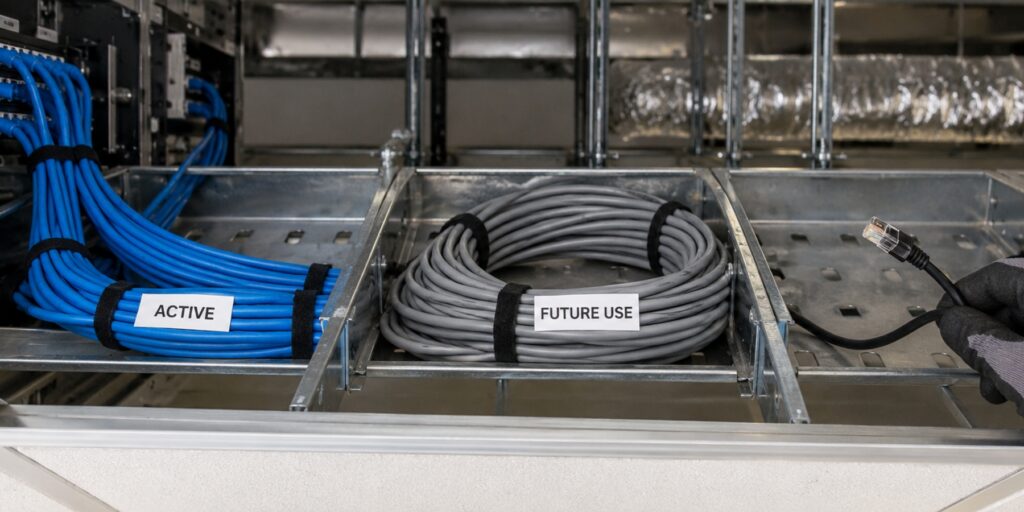
Not every cable above the ceiling is a problem, so the first job is to sort what is there. Some cabling is active and still carries data, voice, video, or alarm signals. Some is set aside for future use and, under electrical code, should carry a durable tag that says so. Some belongs to the building, and some belongs to you as the tenant.
The rest is abandoned, meaning it is no longer connected to equipment at both ends and is not tagged for future use.
That last group matters most. The National Electrical Code defines abandoned communications cable and calls for the accessible portion to be taken out. “Accessible” generally means cable you can reach without tearing into permanent walls or finishes, such as the runs above lay-in ceiling tiles. This is where abandoned cable removal usually focuses, and it is why above-ceiling cable removal often makes up the bulk of a move-out cleanup. Cable sealed inside walls or conduit is treated differently.
Why Abandoned Cabling Can Become a Problem
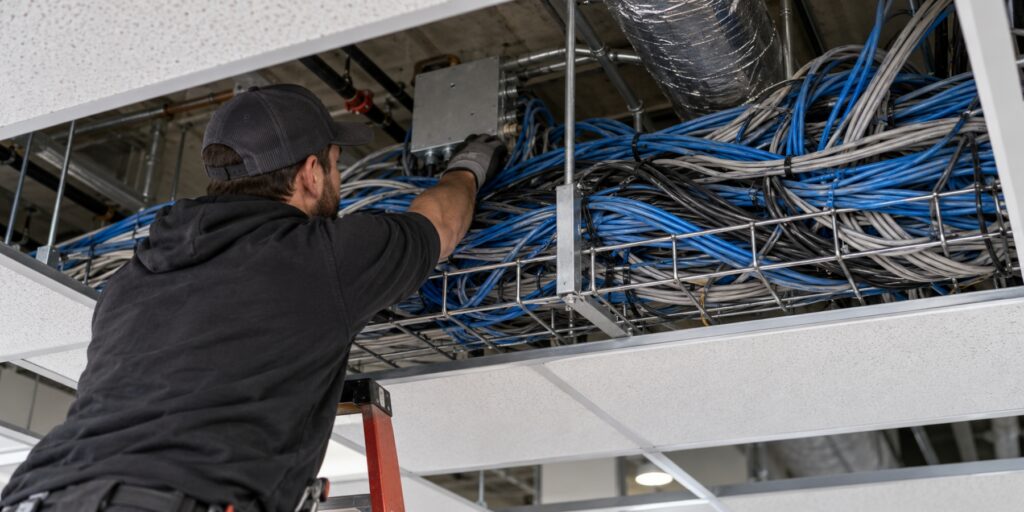
Unused cable rarely causes a dramatic event, but it creates a steady, low-level risk that adds up over the years. Stacks of old cable above a ceiling add combustible material to the space. That is the main reason electrical codes ask for its removal: the goal is to slow the spread of fire and smoke, not to claim the cable itself is likely to start one.
For scale, electrical problems such as short circuits and wiring faults were behind about 7 percent of the roughly 111,900 fires reported in nonresidential buildings during 2024, according to the U.S. Fire Administration. That is a fair reminder of why building codes take wiring and fuel load in ceilings seriously.
The concerns are not only about fire. Overstuffed cable trays block access to other building systems. Mystery cables create confusion about what is still live. Extra weight and clutter make future repairs harder. And a space full of unused wiring can slow a move-out inspection or trigger restoration charges near the end of a lease.
What Low-Voltage Cable Removal in Austin Actually Involves
Good low-voltage cable decommissioning starts with an assessment, not a dumpster. A qualified cabling partner walks the space and records what cabling is present, which systems each run supports, what is active, what belongs to the building or a carrier, what can stay for future use, and what is truly abandoned. That record protects active infrastructure and gives you an accurate scope and budget.
Once the plan is set, the work follows a clear order. Technicians disconnect the cabling marked for removal, pull the accessible runs, then clean up and restore the space, which can include patching wall openings and replacing ceiling tiles. Solid documentation of the finished job gives you proof for the property manager or inspector.
The cabling can cover a lot of ground: data and Ethernet, telephone lines, fiber, security-camera and access-control wiring, alarm and audiovisual cabling, plus racks and patch panels when needed. That is why low-voltage cable removal in Austin is rarely a single task. One move-out can fold office cabling removal, broader commercial cable removal, and routine data cable removal into one scope, with a full cabling assessment and cleanup keeping the pieces organized.

Don’t Forget the IDF, MDF, or Network Closet
The telecommunications room goes by many names: the IDF, the MDF, the equipment room, or just the network closet. It is easy to treat it as someone else’s job, but it usually holds the most valuable and most tangled equipment in the building.
Inside, you may find patch panels, network racks, switches and routers, phone-system hardware, security components, fiber terminations, and battery backups. Some of it moves with you. Some belongs to your internet or phone carrier and must go back so you are not billed for lost rented gear. Some stays with the building. And some is old network cabling in Austin buildings that has piled up across several rounds of work and now needs to come out.
Pulling equipment without a plan can cut services too early or leave you scrambling on moving day. Mapping the room ahead of time, and coordinating the network changes, service cutover, and testing, keeps the transition smooth.

Ask These Questions Before You Return the Keys
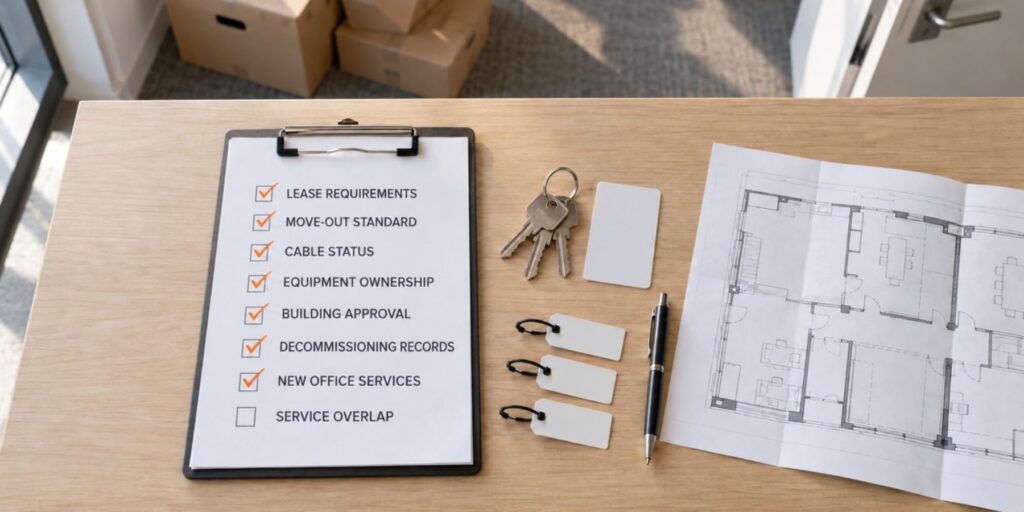
Before your final walkthrough, get clear answers to a few questions. If you cannot answer them, you are not ready to hand back the space.
- What does your lease require you to remove or restore?
- Has the property manager given you a written move-out standard?
- Which cables are active, which are tagged for future use, and which are abandoned?
- Who owns the racks, hardware, and carrier equipment in the room?
- Does any work need building approval or after-hours access?
- Who will document the finished decommissioning?
- Have you planned the internet, network, phones, and security at the new office?
- How much overlap do you need so services do not go dark during the switch?
Your Move-Out and Move-In Plans Should Be Connected
You cannot decommission the old office well without knowing what needs to travel to the new one. The two plans depend on each other. Every cable you pull and every piece of gear you unplug should line up with a decision about what the new site needs on day one.
The new location brings its own list. You may need new structured cabling, Wi-Fi coverage, phones, and conference-room technology. Business internet often has the longest lead time of all, so carrier availability at the new address is worth checking early, well before the move date is fixed. If your current space uses cameras and door access, plan how to move or redesign your cameras and access control so the new office is covered the moment people walk in.
Treating office move cabling as one connected project across both sites is what keeps an Austin office relocation on schedule.
How BestLine Supports Your Austin Office Move
BestLine works as a coordination partner for the whole technology side of a move, not just the part that pulls old wire. That includes assessing cabling at your current site, handling low-voltage cable removal in Austin, and planning fresh cabling, internet, network and Wi-Fi, phones, cameras, and access control at the new one. It also covers the steps that are easy to forget: equipment relocation, service cutover, and testing after everyone arrives.
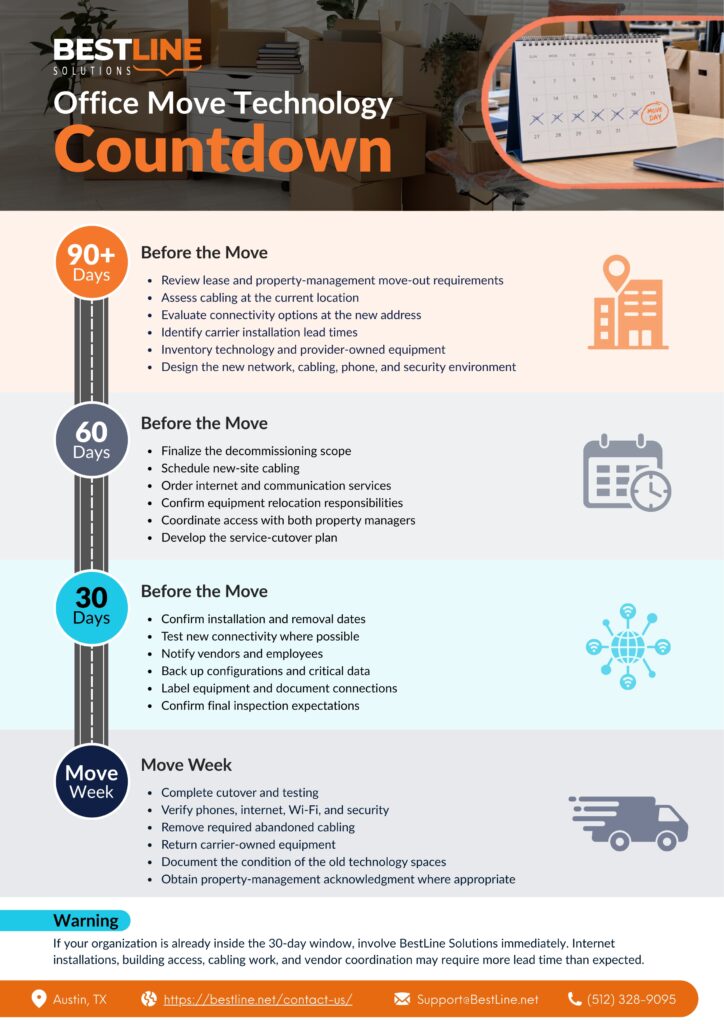
The most useful thing you can do is reach out early. Let BestLine know as soon as a move is on the table, even if the new address and dates are not final. More lead time means fewer rushed decisions and fewer surprises.
For a step-by-step planning tool, the Office Move Blueprint: Technology Edition walks you through what to line up and when.

Frequently Asked Questions About Low-Voltage Cable Removal
The cost of low-voltage cable removal in Austin depends on the amount of wiring, accessibility, building size, and labor required. Offices with extensive cabling above suspended ceilings or multiple network closets may require more work. An on-site assessment helps determine which cables need removal and provides a more accurate estimate before your office move.
The timeline depends on the size of your office, the number of abandoned cable runs, and how easily technicians can access them. Smaller projects may be completed within a day, while larger commercial spaces can take several days or longer. Schedule an assessment before your move-out deadline to allow enough time for removal, cleanup, and any required inspections.
Simply cutting abandoned cables and leaving them above an accessible ceiling generally does not satisfy applicable National Electrical Code removal requirements. Accessible abandoned communications cabling typically must be removed unless it is properly identified for future use. A qualified low-voltage contractor can determine which cables need to be removed and which can safely remain under the applicable code.
Yes. Removing the wrong cable can interrupt internet connections, phone systems, security cameras, or other connected equipment. Before beginning work, technicians should trace and identify existing cables to distinguish active connections from abandoned wiring. Careful planning and coordination help reduce the risk of unexpected downtime during office renovations or relocations.
Existing Ethernet cables may be reusable if they are in good condition, meet the new network’s requirements, and can be retained or relocated appropriately. However, permanently installed cabling generally cannot be transferred to another building as easily as routers, switches, or computers. A cabling assessment can help determine whether existing wiring should remain, be removed, or be replaced at the new location.
Before You Pack, Look Above the Ceiling
Cabling is easy to ignore because you cannot see most of it. That is exactly what makes it a last-minute headache when a lease is ending and the inspection is close. A short assessment early in the process turns a hidden requirement into a simple line item.
If a move is even a possibility, loop in your technology partner now so both the old and new spaces sit inside one plan. You can start that conversation with BestLine whenever the idea of moving first comes up. The earlier the call, the smoother the move.